Cross-Platform Adaptation Patterns in Grid Logic and Set Matching Mechanics for Digital Entertainment Systems

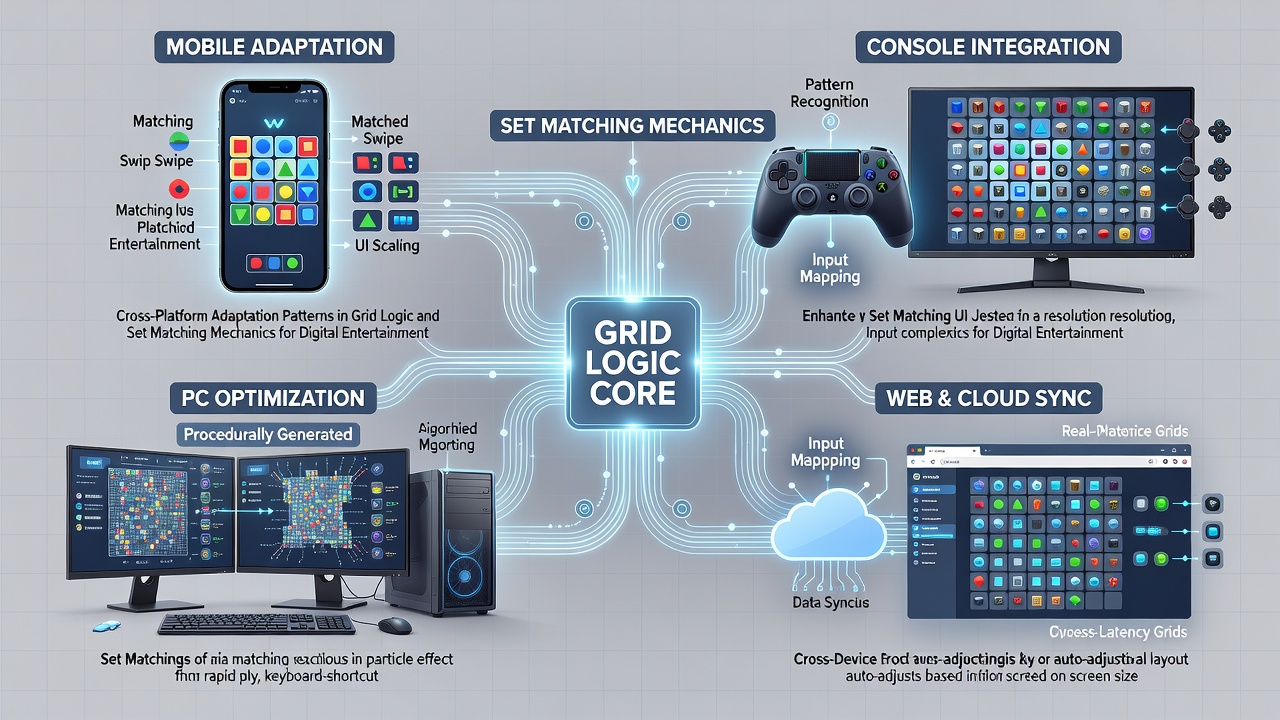
Grid logic structures form the backbone of many digital entertainment systems where players interact with rows, columns, and cells to solve placement challenges, while set matching mechanics require identification and pairing of elements based on shared attributes such as color, shape, or value. These components appear across platforms ranging from mobile applications to console environments and web browsers, requiring developers to adjust rendering engines, input handling, and performance optimization routines for each target device. In June 2026 several major platforms released updated software development kits that standardized grid scaling protocols, allowing consistent cell alignment when users switch between touch screens and controllers without recalibrating core matching algorithms.
Grid Logic Adjustments for Varying Display Resolutions
Developers map grid dimensions to device pixel densities by applying dynamic scaling factors that preserve logical relationships between cells while accommodating different aspect ratios. Research from the University of Melbourne indicates that grid-based systems maintain solvability rates above 94 percent when cell spacing adjusts proportionally rather than through fixed pixel counts. Console versions often incorporate larger cell buffers to support high-definition output, whereas mobile builds compress grid margins to fit smaller viewports without clipping interactive zones. This adaptation preserves the underlying constraint satisfaction rules that govern valid placements across sessions.
Set Matching Implementation Across Input Methods
Set matching logic detects combinations through attribute comparison loops that run identically on each platform, yet the presentation layer changes to match controller schemes. Touch interfaces register selections via direct coordinate mapping, while gamepad navigation translates directional inputs into grid traversal sequences. Data from the Entertainment Software Association shows that matching accuracy remains within 2 percent variance across input types when the backend attribute database stays synchronized. Hybrid titles released in early 2026 demonstrated that set validation routines execute in under 16 milliseconds on mid-range hardware once developers preload comparison tables into device memory.
Performance Considerations in Cross-Platform Deployment
Resource allocation differs notably between platforms because grid rendering demands vary with resolution and refresh rate. Mobile processors handle simplified lighting calculations on grid backgrounds to conserve battery life, while desktop and console builds apply full shader pipelines without performance drops. Observers note that set matching operations benefit from shared code libraries that compile to native instructions, reducing the need for separate validation engines. When systems encounter network latency during multiplayer sessions, developers insert client-side prediction buffers that keep local grid states consistent until server reconciliation occurs.
Interface Synchronization Techniques
Cross-platform titles maintain state parity by transmitting compact grid snapshots rather than full visual frames, which cuts bandwidth usage by approximately 60 percent according to industry benchmarks. Developers embed checksum routines that verify set integrity after each player action, preventing desynchronization when devices operate on mismatched frame timings. Web-based implementations rely on canvas elements that redraw only modified cells, whereas native applications leverage hardware acceleration for the same updates. These methods ensure that pattern recognition remains reliable whether users access content through browsers or dedicated applications.
Testing Protocols for Consistency
Quality assurance teams run automated suites that simulate thousands of grid configurations on each supported platform before release. Automated scripts compare matching outcomes against reference solutions stored in shared repositories, flagging discrepancies that exceed a single cell offset. Human testers then verify edge cases involving rapid input sequences that stress both grid navigation and set validation simultaneously. Reports compiled by the European Games Developer Federation highlight that such layered testing reduces post-launch patching requirements by 35 percent for titles featuring complex matching systems.
Conclusion
Adaptation patterns for grid logic and set matching continue to evolve as new hardware profiles enter the market, yet the core mathematical structures remain stable across implementations. Consistent attribute handling, proportional scaling, and synchronized state management allow these mechanics to function reliably whether deployed on portable devices or stationary consoles. Continued refinement of shared libraries and validation protocols supports broader accessibility without compromising the logical integrity that defines these entertainment systems.