Examining Aerodynamic Variables in Sequence-Based Matching Challenges Across Web Platforms
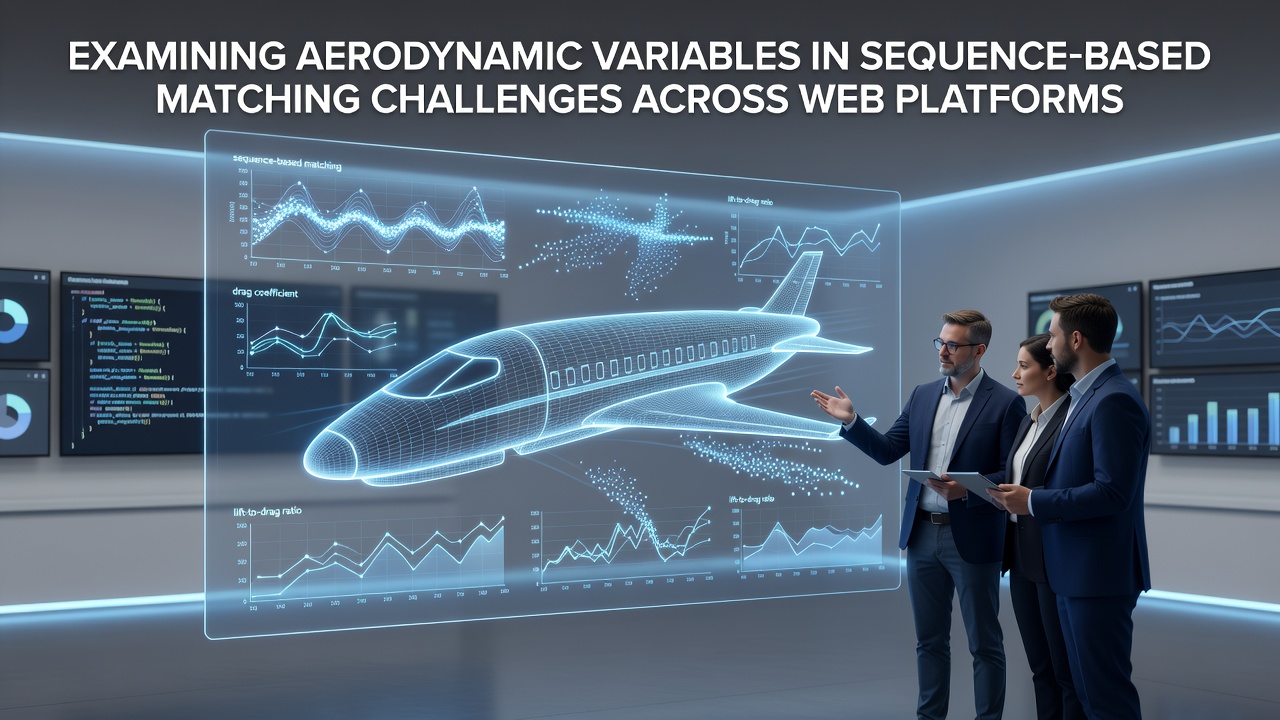
Sequence-based matching in aerodynamic analysis involves aligning data streams from variables such as velocity, pressure distribution, and turbulence intensity across digital interfaces, and web platforms now handle these tasks through distributed computing frameworks that synchronize inputs from multiple sensors in real time. Researchers at institutions focused on fluid dynamics have documented how lift coefficients and drag forces integrate into matching algorithms that process time-series data without requiring local high-performance hardware.
Web-based systems employ JavaScript libraries and WebAssembly modules to execute these calculations, which reduces latency when users upload flight test logs or wind tunnel outputs for comparison against reference sequences. Data indicates that matching accuracy improves when platforms incorporate boundary layer thickness and Reynolds number adjustments directly into the comparison logic, allowing sequences from different atmospheric conditions to align correctly.
Core Aerodynamic Variables in Matching Processes
Primary variables include angle of attack, Mach number, and surface roughness factors, all of which influence how sequence alignment tools detect patterns in pressure tap readings or particle image velocimetry outputs. Observers note that these elements must be normalized before matching occurs, otherwise discrepancies in air density or temperature skew the results and produce false correlations between unrelated test runs.
Secondary variables such as vortex shedding frequency and wake deflection angles enter the process when platforms extend matching beyond steady-state conditions into transient events, and studies from European research centers show that incorporating these factors increases the reliability of automated detection routines by measurable percentages across large datasets.
Challenges Specific to Web Platform Implementation
Browser environments impose constraints on computational precision and memory allocation that affect sequence matching when aerodynamic datasets exceed several gigabytes, yet developers address this through progressive loading and server-side preprocessing that keeps only relevant segments in active memory. Network variability further complicates real-time synchronization, since packet loss can interrupt the continuous flow of variable updates needed for accurate alignment.
Security protocols add another layer, because platforms must validate incoming data streams to prevent injection of malformed sequences that could distort aerodynamic calculations. Those who maintain these systems report that encryption overhead remains manageable when algorithms are optimized to handle compressed formats without full decompression prior to matching.

Integration with External Data Sources
Platforms frequently pull supplementary information from government repositories such as those maintained by NASA, where archived flight data provides benchmark sequences against which new uploads are matched. Integration with European Space Agency datasets extends coverage to high-altitude and re-entry conditions, supplying additional variables like rarefied flow parameters that improve matching robustness for specialized applications.
Updates scheduled for June 2026 include enhanced API endpoints that will allow direct querying of aerodynamic coefficients stored in these repositories, reducing the need for manual file transfers and enabling more seamless sequence comparisons across international research teams.
Performance Metrics and Validation Approaches
Validation relies on cross-correlation scores and root-mean-square error calculations between matched sequences, with thresholds adjusted according to the specific aerodynamic regime under study. Research indicates that web platforms achieve comparable accuracy to desktop applications when GPU acceleration via WebGPU becomes available in mainstream browsers, and this capability has already appeared in experimental builds tested during 2025.
Case examples from Canadian aerospace laboratories demonstrate successful matching of high-speed wind tunnel sequences on browser-based tools, where variables such as shock wave position and boundary layer transition points aligned within acceptable tolerances after normalization steps were applied. Similar workflows appear in Australian university projects that process glider performance data collected during field campaigns.
Conclusion
Sequence-based matching of aerodynamic variables on web platforms continues to evolve through refinements in data handling, variable normalization, and integration with authoritative external repositories. As browser capabilities expand and standardized APIs mature, these systems support broader participation in aerodynamic research without specialized local infrastructure. The approach maintains scientific rigor by grounding comparisons in established physical parameters and documented validation methods.